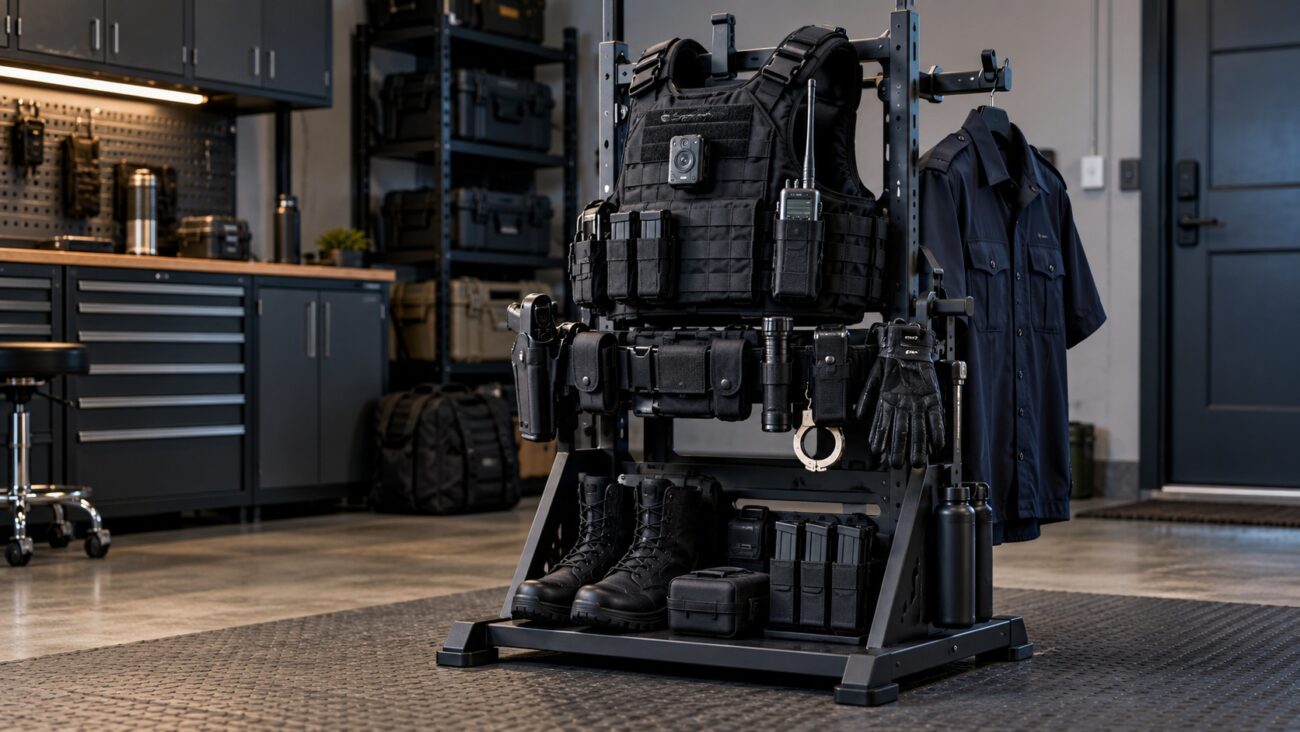
You get home after a long shift, the vest comes off, the duty belt comes off, the radio gets dropped somewhere, boots wind up by the door, and suddenly half your work gear is living on a chair.
Anybody who has carried a full law enforcement loadout knows the problem.
Police gear does not store particularly well on a normal coat rack. There is too much of it, some of it is heavy, and different pieces need different places to live. A duty belt does not hang like a jacket. Body armor takes up space. Radios and electronics may need charging. Gloves, cuffs, keys and other small items have a habit of disappearing exactly when you need them.
That was the problem the 1096 Sheepdog Stand was designed to solve.
Unfortunately, the original Sheepdog Stand is no longer available.
The good news is that police gear racks have become much easier to find, and there are several current alternatives that follow the same basic idea: give your vest, belt, uniform and everyday duty equipment one dedicated place instead of dumping everything on the nearest chair.
What Was the 1096 Sheepdog Stand?
The Sheepdog Stand was a dedicated law enforcement gear organizer built around the equipment an officer actually brings home.
It was not just a clothing rack.
The original setup included dedicated supports for a duty belt and ballistic vest, along with a removable post for hanging a uniform shirt. There was also a side tray for smaller equipment.
One of the more interesting features was the storage compartment at the top.
Different configurations were available, including keypad and RFID access as well as a fingerprint option. The stand shown in the original demonstration also had an optional motion-activated interior light.
The basic idea was simple.
Come home. Put the gear in one place. Know exactly where it is when you go back on duty.
That sounds obvious until you look at how much equipment a patrol officer may actually carry.
A normal loadout can include:
- Ballistic vest or outer carrier
- Duty belt
- Service pistol and holster
- Spare magazines
- Handcuffs
- Taser
- Radio
- Body camera
- Flashlight
- OC spray
- Baton
- Tourniquet or medical equipment
- Gloves
- Keys
- Uniform shirt
- Boots
- Phone and other everyday carry items
We covered the weight side of this in our guide to how much police gear weighs. Once you start dealing with 20, 30 or more pounds of equipment, a random closet hook starts looking like a pretty lousy storage system.
The Sheepdog Stand Is No Longer Available
If you found an old video, photograph or reference to the Sheepdog Stand and came here looking to buy one, there is one important thing to know:
The original 1096 Sheepdog Stand is no longer being sold.
That is why this page focuses on the next question.
What can you buy now that does roughly the same job?
There is no exact one-for-one replacement that I would call the new Sheepdog Stand. The original had a specific combination of vest storage, belt storage, uniform hanging space, a tray and lockable storage.
Instead, I would look at current police gear stands based on which parts of that design actually matter to you.
Best Sheepdog Stand Alternatives
Here are three current Amazon options worth comparing if you are looking for a police tactical gear stand.
| Gear stand | Best fit |
|---|---|
| Guard The Line Police Gear Rack | Best overall Sheepdog Stand-style replacement |
| Heavy-Duty Police Tactical Gear Organizer | Good alternative if you want another freestanding setup |
| Guard The Line Police Gear Rack / Cop Caddy Style | Good choice if you mainly want straightforward vest and duty-belt organization |
Amazon listings, configurations and availability change, so check the current product page before ordering.
Guard The Line Police Gear Rack
Best Overall Alternative to the Sheepdog Stand
View the Guard The Line Police Gear Rack on Amazon
If what you liked about the Sheepdog Stand was the idea of having a dedicated freestanding station for your entire patrol loadout, this is the first option I would look at.
The important distinction is that this is designed as a police gear rack rather than a generic clothing stand.
That matters.
A normal valet stand might handle a pair of pants, shirt and jacket just fine. Police gear brings a loaded duty belt and body armor into the equation.
Those two pieces alone change the requirements.
You want something that gives your vest a proper place to hang while also keeping the belt supported and off the floor. The rest of the gear can then be organized around those two main items.
For somebody trying to recreate the basic Sheepdog Stand experience, this is probably the closest place to start.
Good fit for:
- Patrol officers
- Deputies
- Corrections officers with take-home gear
- Military personnel
- Security professionals
- Anyone with a full vest and belt setup
The big advantage is not complicated.
Everything gets a home.
When you walk in the door, the vest goes here. Belt goes there. Uniform and accessories go with them.
Next shift, you are not walking around the house looking for a flashlight you left on the kitchen counter.
Heavy-Duty Police Tactical Gear Organizer
Another Freestanding Police Gear Stand Option
View this police tactical gear organizer on Amazon
This is another option worth comparing if you want a dedicated rack rather than trying to build a storage system out of wall hooks, hangers and closet shelves.
That is really the line I would draw when shopping for one of these.
If your duty setup is relatively minimal, you may not need a full stand.
If you are coming home with a vest, loaded belt, radio, body camera, gloves, boots and assorted equipment every night, a purpose-built organizer starts making a lot more sense.
Look closely at the current listing and compare:
- Vest support
- Duty-belt hanging points
- Overall load capacity
- Base stability
- Storage for smaller equipment
- Space required on the floor
- Assembly requirements
- Whether any secure storage is included
That last point is especially important.
A gear organizer is not automatically secure storage.
If you plan to store a firearm or other restricted equipment with the stand, determine whether the product actually includes a lockable compartment suitable for your needs. If it does not, use a separate secure-storage solution consistent with department policy, manufacturer guidance and applicable law.
Guard The Line Police Gear Rack
A Simpler Police Gear Organization Option
View this Guard The Line police gear rack on Amazon
The third option is worth looking at if the main thing you need is a dedicated place for the basic patrol setup.
For a lot of officers, that is really the problem.
The gear itself is not disorganized because there are 100 different pieces. It is disorganized because the three or four bulky pieces have nowhere good to go.
The vest winds up on a chair.
The belt gets tossed on a desk.
The uniform shirt gets hung over something.
Boots are somewhere underneath all of it.
A dedicated police gear rack solves the problem by creating one staging area.
That word is probably more accurate than “storage.”
You are not necessarily putting your equipment away for six months.
You are staging it for tomorrow.
That is a very different use case.
What to Look for in a Police Tactical Gear Stand
A good police gear stand should be selected around your actual loadout, not around which rack looks coolest in a product photo.
Vest Support
Start with the body armor.
If you wear an outer carrier or ballistic vest every day, make sure the stand gives it enough room and adequate support.
Follow the armor manufacturer’s storage instructions. If the armor is approved for hanging, a broad, stable support is preferable to improvising with whatever narrow hook happens to be available.
Duty Belt Storage
This is one of the biggest differences between a police gear rack and a normal clothes organizer.
A loaded duty belt is heavy and awkward.
You want a dedicated support that allows the belt to hang without dumping everything onto the floor.
Ideally, you should also be able to remove and replace it without having to rearrange half the stand.
A Place for Small Gear
Think about all the stuff that comes out of your pockets or off your uniform at the end of a shift.
- Keys.
- Gloves.
- Flashlight.
- Wallet.
- Knife.
- Body camera.
- Radio accessories.
Loose equipment is where a tray or shelf becomes surprisingly useful.
The old Sheepdog Stand included a side tray for exactly this reason.
Charging Access
Modern police equipment creates another problem that older gear racks did not have to address.
Batteries.
Body cameras, radios, flashlights and other electronic equipment may need to be charged between shifts.
If electronics are part of your normal routine, think about where the stand will be located and how easily charging cables can reach it.
A stand sitting six feet from the nearest outlet may become annoying fast.
Boots
This sounds minor until there is nowhere to put them.
A base or lower shelf can help keep boots with the rest of the uniform instead of creating a second pile of gear somewhere else in the room.
Secure Storage
This is where you need to separate organization from security.
The original Sheepdog Stand offered a lockable upper compartment with electronic access options.
Not every modern police gear rack does.
If you specifically want to store a duty weapon, backup weapon or other controlled equipment on or inside the stand, look for a genuine secure-storage solution rather than assuming a shelf or drawer counts as one.
Stability
Police gear is heavy.
The rack needs to stay planted when you pull a loaded belt off one side or drop a vest onto it.
A stand that looks good empty but starts leaning when 25 pounds of equipment gets loaded onto one side defeats the purpose.
Freestanding Stand or Wall-Mounted Police Gear Rack?
There is another decision worth making before you buy anything.
Do you actually want a freestanding tactical gear stand?
Freestanding Gear Stand
A freestanding design is usually better if you want the same basic experience the Sheepdog Stand offered.
Everything is contained in one station, and you can place it near a garage entrance, bedroom, mudroom or wherever you normally remove your equipment.
It is also easier to relocate.
The downside is obvious.
It takes up floor space.
Wall-Mounted Gear Rack
Wall-mounted police racks can be a better choice in small rooms, closets or garages.
They get the equipment off the floor and can provide excellent organization.
The tradeoff is that installation matters. You are hanging heavy equipment from the wall, so proper mounting is not optional.
A wall rack also becomes a much more permanent part of the room.
Neither system is automatically better.
Pick the one that matches how you actually come home and strip your gear.
Do You Really Need a Police Gear Stand?
Maybe not.
If your take-home equipment consists of a radio, belt and a couple of small items, a shelf and a good hanger may be perfectly adequate.
But there is a point where normal household storage stops working very well.
If you regularly bring home:
- Body armor
- Loaded duty belt
- Uniform
- Boots
- Radio
- Body camera
- Medical gear
- Flashlights
- Gloves
- Other duty equipment
then a dedicated law enforcement gear organizer starts making sense.
There is another benefit too.
You can visually check your equipment before leaving.
- Vest.
- Belt.
- Radio.
- Camera.
- Cuffs.
- Medical.
Everything is right there.
That may be the biggest advantage of the entire setup.
Which Sheepdog Stand Alternative Should You Buy?
If I were trying to replace the old Sheepdog Stand today, I would start with the Guard The Line Police Gear Rack.
It follows the same basic concept most closely: one freestanding location for the core pieces of a law enforcement loadout.
The second Amazon gear organizer is worth comparing if you want another full-size setup or prefer its layout.
The third Guard The Line option makes sense if your priority is simply getting the vest, belt and daily equipment organized instead of recreating every feature of the original Sheepdog Stand.
None of them need to duplicate the old product exactly to solve the same basic problem.
The End-of-Shift Test
The best police tactical gear stand is the one you will actually use when you are tired.
That is the real test.
You get home after a long shift. You do not want to carefully inventory twelve pieces of equipment and arrange everything like a showroom display.
You want to walk in, strip the gear, put it where it belongs and be done.
That was what made the 1096 Sheepdog Stand a useful idea in the first place.
The original stand is gone, but the problem it solved definitely is not.
A good replacement should give your vest, duty belt, uniform and everyday equipment one predictable place to live, keep the pile of gear off the furniture, and make getting ready for the next shift a little easier.
That is the standard I would use when choosing one.
