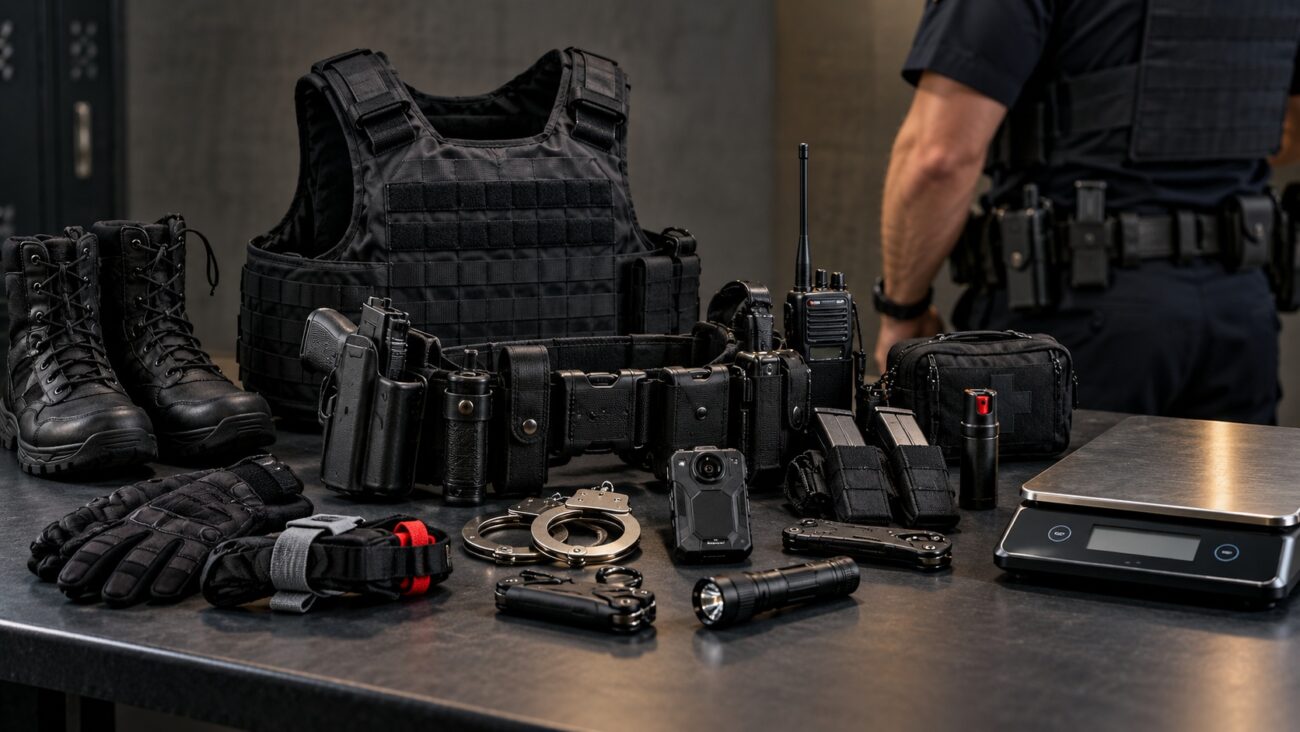
Watch a uniformed patrol officer step out of a cruiser and it is easy to underestimate how much equipment is moving with them.
The sidearm is obvious. So is the body armor. Then there is the radio, spare ammunition, handcuffs, Taser, body camera, flashlight, medical gear and the belt or outer carrier holding much of it together.
It adds up quickly.
A typical patrol officer may carry roughly 20 to 30 pounds of police gear during a normal shift. The exact number depends on the department, assignment, body armor and individual loadout. Specialized officers can carry considerably more.
A 2026 study that physically weighed officers before and after putting on their duty equipment found general-duty police carried an average of 20.9 pounds of equipment. Specialist police averaged about 34.7 pounds.
Those numbers line up surprisingly well with what individual police departments have reported. Tukwila Police Department, for example, says a fully loaded duty setup with its minimum required equipment weighs approximately 25 to 30 pounds.
There is no single number that applies to every officer.
That is the important part.
How Much Does Police Gear Weigh on Average?
For a uniformed patrol officer, 20 to 30 pounds is a reasonable real-world range for the equipment worn during a typical shift.
That does not mean every officer carries 25 pounds.
Some carry less. Others carry substantially more, particularly when hard armor plates, additional ammunition, medical equipment or specialized tactical gear enter the picture.
One of the better recent measurements comes from a 2026 study of 88 officers from an Australian state police service. Researchers weighed officers in uniform without their duty load and then again with their equipment.
The results show how much assignment matters.
| Police assignment | Average equipment load |
|---|---|
| Plainclothes officers | About 14.8 lb |
| General-duty officers | About 20.9 lb |
| Bicycle officers | About 22.9 lb |
| Specialist police | About 34.7 lb |
These figures should not be interpreted as a universal police equipment standard, especially since departments in the United States may issue different equipment.
They do provide something valuable, though.
They are measured loads rather than guesses.
American departments have reported similar numbers. Tukwila Police Department places its standard loaded equipment at approximately 25 to 30 pounds. Minneapolis police have also been publicly photographed and described carrying roughly 30 pounds of equipment.
That gives us a useful baseline:
20 to 30 pounds is normal territory for patrol gear. Once specialized armor and tactical equipment are added, the load can move well beyond that range.
What Does a Police Officer Actually Carry?
The phrase “police gear” can be misleading because it sounds like one piece of equipment.
It is really a system.
An officer may have equipment mounted on the duty belt, attached to an outer vest, carried in uniform pockets and secured in other locations on the body.
Tukwila Police published a useful example of what its uniformed officers carry each day. Its list includes a pistol with weapon light, two spare magazines, Taser, two sets of handcuffs, baton, radio, flashlights, tourniquets, knife, body-worn camera, keys, gloves, pen and phone.
And that is before getting into specialized equipment that might be carried for a particular assignment.
The Police Duty Belt
The traditional police duty belt does a tremendous amount of work.
Depending on department policy and how the officer configures it, the belt may carry:
- Service pistol and holster
- Spare magazines
- Handcuffs
- Taser
- OC or pepper spray
- Expandable baton
- Radio
- Flashlight
- Tourniquet or medical equipment
- Keys
- Gloves and miscellaneous equipment
Duty belts may be constructed from leather, nylon or other synthetic materials. The construction of the belt itself matters, but most of the weight comes from what gets attached to it.
A 2025 study examining the physical impact of police protective equipment listed an unloaded duty belt at 3.4 pounds in the configuration studied. Once the pistol, ammunition, radio, Taser and everything else were added, the load increased substantially.
Body Armor and Outer Carriers
Body armor accounts for another significant portion of an officer’s load.
There is no useful answer to “How much does a police vest weigh?” without first asking what kind of vest we are talking about.
A concealable soft body armor vest is different from an outer carrier covered with equipment.
Both are different from a plate carrier containing hard rifle-rated armor plates.
The 2025 police mobility study used a protective vest weighing 6.4 pounds.
That provides a useful example, but it should not be treated as the standard weight of all police body armor.
Armor size, protection level, carrier design and attached equipment all change the final number.
Add hard armor plates and the weight can rise quickly.
Uniform, Boots and the Equipment Nobody Thinks About
People often count the firearm and armor while forgetting everything else.
Boots add weight.
So do a body camera, radio microphone, gloves, keys, phone, tourniquets and whatever equipment is carried in the officer’s pockets.
Even the method used to answer the question can create confusion.
One officer might say, “My gear weighs 25 pounds,” meaning the equipment itself.
Another might weigh himself in normal clothing and then again wearing his complete uniform, boots, armor and equipment.
Both may be telling the truth while reporting different numbers.
How Much Does Each Piece of Police Gear Weigh?
Police departments do not all use the same brands or models, so individual equipment weights vary.
Still, researchers have provided a useful example.
A 2025 study of police protective gear used the following equipment weights:
| Equipment | Weight used in study |
|---|---|
| Protective vest | 6.4 lb |
| Unloaded duty belt | 3.4 lb |
| Pistol | 2.4 lb |
| Radio | 1.8 lb |
| Taser | 1.0 lb |
| Loaded magazine | 0.6 lb |
| Handcuffs | 0.4 lb |
| Body camera | 0.4 lb |
| Flashlight | 0.4 lb |
| Pepper spray | 0.3 lb |
There is a good lesson in that table.
No single piece necessarily seems extraordinarily heavy.
Carry all of them at the same time for an entire shift and it becomes a different situation.
The belt, vest and pistol in that particular configuration already total more than 12 pounds. Add ammunition, radio, cuffs, Taser, camera, OC spray, flashlight and additional equipment and the weight keeps climbing.
That is why simply picking up a police duty belt does not necessarily tell you what an officer carries during an actual shift.
Real Police Loadouts Can Be Surprisingly Heavy
One of the reasons estimates for police gear weight seem to be all over the map is that real officers’ loadouts actually are all over the map.
Department requirements differ.
Assignments differ.
Officers may also have some discretion over where authorized equipment is positioned.
Tukwila Police puts its required load at approximately 25 to 30 pounds.
A recent controlled study measured general-duty police at approximately 20.9 pounds and specialist police at about 34.7 pounds.
Individual officers reporting their own weights online have described setups ranging from roughly 20 pounds into the 30 and 40-pound range.
Those firsthand accounts are useful, but they should be treated as anecdotes rather than an average for law enforcement as a whole.
What they show is the enormous variation behind what sounds like a simple question.
Why Two Police Officers May Carry Very Different Amounts of Gear
Put two officers from different agencies side by side and their equipment could look similar while weighing considerably different amounts.
Several factors determine the final load.
Department Policy
Some police departments require equipment that others make optional.
One agency may require two sets of handcuffs. Another may require one.
Some officers carry a baton. Others may not.
The same applies to OC spray, Taser cartridges, medical equipment and other tools.
Assignment
A school resource officer, patrol officer, detective and SWAT officer do not necessarily need the same equipment.
The 2026 police load study demonstrates this clearly.
Plainclothes officers averaged approximately 14.8 pounds of equipment. General-duty officers averaged about 20.9 pounds. Specialist police were carrying nearly 35 pounds on average.
Job function changes the load.
Body Armor
Soft armor alone may account for several pounds.
Add a tactical outer carrier and equipment attached to it and the weight rises.
Add hard armor plates for rifle threats and it rises again.
There is a major difference between the ballistic vest worn by a patrol officer throughout an ordinary shift and the tactical armor worn during a high-risk operation.
Where the Equipment Is Carried
An officer may carry equipment primarily on a traditional duty belt.
Another may move the radio, magazines, medical equipment or other items onto a load-bearing outer vest.
That may not remove much weight.
It changes where the weight is being carried, which can be just as important.
How Much Does Police Body Armor Weigh?
There is no single weight for police body armor.
The answer depends on the protection system.
Soft body armor intended for everyday patrol use can weigh several pounds. The protective vest used in one recent police study weighed 6.4 pounds.
Hard armor is another matter.
A plate carrier may contain front and rear ballistic plates and sometimes side plates. Equipment may then be mounted directly to the carrier.
That means the phrase “police vest” can describe anything from relatively lightweight concealable armor to a heavily equipped tactical armor system.
When comparing police body armor weight, ask four questions:
- Is it soft armor or hard armor?
- What ballistic protection level is being used?
- Are front, rear or side plates installed?
- Is the quoted number for the armor alone or for a fully loaded outer carrier?
Without those details, two apparently conflicting numbers may actually describe completely different configurations.
How Heavy Is SWAT Gear?
SWAT and other tactical officers generally carry more weight because the mission is different.
A patrol officer must be ready for a broad range of calls.
A tactical officer preparing for a high-risk operation may add hard armor plates, a ballistic helmet, rifle, rifle ammunition, additional medical equipment and other mission-specific gear.
That difference shows up in measured data.
In the 2026 study, specialist police carried an average equipment load of approximately 34.7 pounds, compared with about 20.9 pounds for general-duty officers. The specialist load amounted to roughly 17% of the officers’ body weight on average.
That does not establish 35 pounds as “the weight of SWAT gear.”
It establishes something more useful.
Specialized police duties can require considerably more carried equipment than ordinary patrol.
Depending on armor, weapons and mission equipment, some high-risk loadouts can exceed 40 pounds.
Does All That Police Gear Affect Mobility?
Absolutely.
Twenty pounds does not sound extreme when it is sitting on a table.
Carrying it around the waist and torso while walking, running, sitting, kneeling, driving and repeatedly entering or exiting a vehicle is another matter.
A 2025 study examining police officers with and without protective gear found that the equipment negatively affected several measures of mobility, stability and power generation.
The effect is not simply a matter of whether an officer can lift 20 or 30 pounds.
Police equipment is worn continuously.
A patrol officer may spend hours sitting in a vehicle with a pistol, radio, handcuffs and other equipment pressing against the waist and lower back. Then an ordinary call can suddenly become a foot pursuit.
The equipment needs to stay attached through all of it.
Tukwila Police describes officers getting in and out of vehicles dozens of times during a shift while carrying this equipment. The department specifically points to pressure on the back, hips and knees as a concern associated with long-term gear use.
Duty Belt vs. Load-Bearing Vest: Same Weight, Different Problem
This is where the discussion gets more interesting.
If an officer moves a radio from the belt to an outer carrier, the radio did not suddenly become lighter.
The load changed location.
Traditionally, much of an officer’s equipment was concentrated around the waist on a duty belt. That is convenient for access, but it puts considerable equipment around the hips and lower back.
Modern load-bearing outer carriers allow departments to move some equipment onto the torso.
Tukwila Police says this is one of the reasons its officers transitioned equipment from the duty belt onto outer carriers. The department describes the goal as removing pressure from the hips and back and spreading the weight across the shoulders and chest.
There is research supporting the ergonomic argument.
A 2019 study compared Swedish police officers wearing a conventional duty belt with officers using an alternate load-carriage system incorporating a load-bearing vest. Officers reported less discomfort with the vest system, and researchers measured lower pressure in the lower-back region while officers were seated in police vehicles.
There was a tradeoff. Pressure increased in the upper back.
That is a good reminder that equipment placement is an engineering problem, not simply a matter of making the gear lighter.
The question is not only how much does police gear weigh?
It is also where is that weight being carried for the next eight, ten or twelve hours?
Why Police Gear Keeps Getting Heavier
Police equipment has changed substantially over time.
Some modern equipment is lighter than what officers carried decades ago. Nylon duty gear, polymer equipment and improved armor materials can reduce weight.
At the same time, officers are being issued equipment that previous generations did not routinely carry.
Body-worn cameras are one obvious example.
Electronic control devices are another.
Add medical equipment such as tourniquets, weapon-mounted lights, additional electronics and updated communications equipment and reductions in one area can be replaced by additions somewhere else.
The result is something of a balancing act.
Departments want officers to have the equipment needed for emergencies, but every piece of equipment must be carried somewhere.
The safest possible answer cannot simply be “carry less.”
The operational question is whether equipment is necessary, appropriately selected and carried in a way that reduces unnecessary strain.
How Much Does a Fully Equipped Police Officer Weigh?
That depends on the officer.
But the calculation is simple once the equipment load is known.
A 180-pound officer carrying 25 pounds of gear would weigh approximately 205 pounds fully equipped.
A 200-pound officer carrying 30 pounds would come in around 230 pounds.
A 190-pound tactical officer wearing and carrying 40 pounds of equipment would be moving roughly 230 pounds every time he or she ran, climbed stairs or changed position.
This also explains why body weight alone does not tell you much about the physical demands placed on an officer.
External load matters.
So does how it is distributed.
Frequently Asked Questions About Police Gear Weight
How much does police gear weigh in total?
A reasonable estimate for a typical patrol officer is about 20 to 30 pounds of equipment. A 2026 study measured general-duty officers at approximately 20.9 pounds, while one U.S. police department describes its standard fully loaded equipment as approximately 25 to 30 pounds.
How heavy is a police duty belt?
There is no universal number because the answer depends on what is attached to it. In one 2025 study, the unloaded belt alone weighed 3.4 pounds. Add a pistol, magazines, radio, handcuffs, Taser, OC spray, flashlight and other equipment and the total rises quickly.
How much does a police vest weigh?
It depends on the armor and carrier. One recent police study used a protective vest weighing 6.4 pounds. That should be viewed as an example rather than a universal standard. Hard armor plates and equipment attached to an outer carrier can substantially increase the total weight.
How much does police gear weigh with body armor?
For ordinary patrol configurations, approximately 20 to 30 pounds total is a useful range when body armor, duty equipment and other required items are included. Armor type can move the final number significantly higher.
How heavy is SWAT equipment?
There is no standard SWAT load. Specialist police in a 2026 study carried approximately 34.7 pounds of equipment on average, considerably more than general-duty officers. Tactical armor, rifles, helmets, ammunition and mission-specific equipment can increase the load further.
Do all police officers carry the same equipment?
No. Equipment varies by agency, assignment, department policy and officer role. Patrol, traffic, bicycle, plainclothes and tactical officers may all carry different loadouts.
Does a load-bearing vest make police gear lighter?
Not necessarily.
A load-bearing vest primarily allows equipment to be moved away from the waist and distributed across the torso. Research suggests that this can reduce lower-back pressure and discomfort while sitting in patrol vehicles, although the load itself still exists.
Is it harder to run while wearing police gear?
Additional weight can affect mobility, endurance and power. Research comparing officers with and without their protective equipment has found measurable reductions in aspects of physical performance while gear is worn.
How heavy is an NYPD police vest?
There is not one meaningful weight for an “NYPD vest” without identifying the specific armor system, size, carrier and configuration being worn. Police agencies may use multiple armor configurations for different assignments.
How heavy are FBI vests?
The same problem applies. There is no single weight that represents every FBI armor setup. A concealable soft armor vest, tactical carrier and rifle-rated plate system are different pieces of equipment with very different weights.
The Loadout Bottom Line
So, how much does police gear weigh?
For a typical uniformed patrol officer, roughly 20 to 30 pounds is a solid working estimate.
Measured data supports that range. A 2026 study found general-duty officers carried about 20.9 pounds on average, while specialist officers carried roughly 34.7 pounds. Tukwila Police Department reports approximately 25 to 30 pounds for its standard required load.
But the number alone does not tell the whole story.
A patrol officer may wear that equipment through an entire shift. They sit with it. Walk with it. Run with it. Climb stairs with it. Get in and out of a cruiser with it.
And two officers standing next to each other may be carrying very different loads based on their armor, assignment and department policy.
That is why the most accurate answer is not simply “25 pounds.”
For ordinary patrol, think roughly 20 to 30 pounds. For specialized and high-risk assignments, expect more. And when evaluating the physical burden, where the equipment is carried can matter almost as much as what the scale says.
