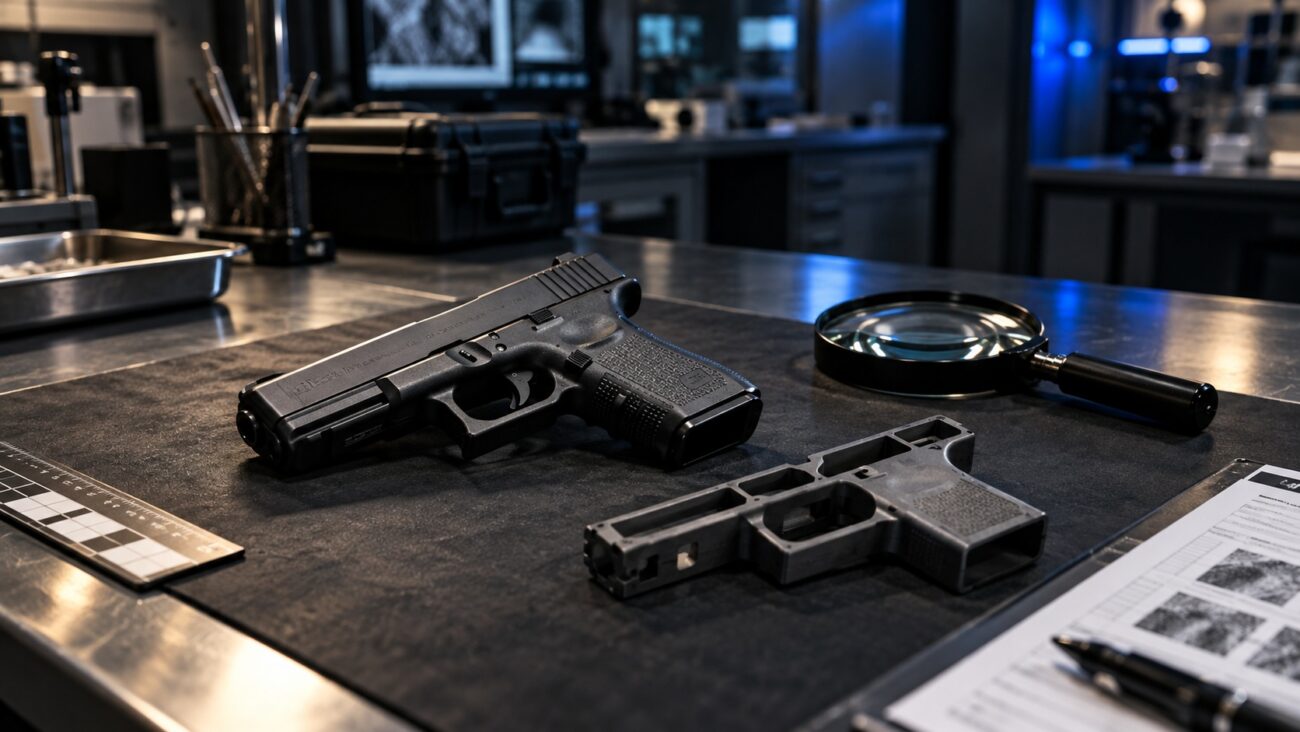
BLUF: Ghost guns, formally known as privately made firearms (PMFs), are firearms manufactured outside the licensed commercial manufacturing process, generally without a manufacturer-applied serial number. They can resemble ordinary handguns or rifles, incorporate unfinished receivers, or contain 3D-printed components. For law enforcement, the biggest challenges involve identifying unfamiliar firearms, documenting them accurately, determining their legal status, and investigating weapons without conventional serial-number records. However, a missing serial number does not automatically make a firearm illegal or impossible to trace through other investigative methods.
An officer recovering a handgun during a traffic stop might recognize its general design immediately. The slide resembles a familiar commercial pistol. The barrel and other components look conventional.
But the frame is unfamiliar, and there’s no manufacturer serial number where one would normally be expected.
Is it a ghost gun? A lawfully manufactured personal firearm? A commercially manufactured gun with altered identification markings?
And what can an officer actually conclude from those observations?
Those questions are becoming increasingly relevant to patrol officers, detectives, evidence technicians, firearms examiners, and prosecutors.
According to the Bureau of Alcohol, Tobacco, Firearms and Explosives (ATF), law enforcement agencies recovered and reported 92,702 suspected privately made firearms between 2017 and 2023. Reports increased substantially during that period.
The challenge isn’t simply recognizing that some firearms are homemade. It’s understanding what their characteristics mean, what they don’t mean, and how conventional investigative methods can still work.
What Is a Ghost Gun? A Law Enforcement Definition
A ghost gun is the common name for a firearm that has been privately manufactured and lacks the serial number normally applied by a licensed manufacturer.
The ATF uses the more precise designation privately made firearm, abbreviated PMF.
Federal regulations define a PMF as a firearm, including a frame or receiver, completed, assembled, or otherwise produced by someone other than a licensed manufacturer, without a serial number placed by a licensed manufacturer when it was produced.
These firearms aren’t limited to crude homemade weapons.
A PMF may resemble a conventional Glock-style pistol, an AR-15-pattern rifle, or another common firearm platform. Some incorporate commercially manufactured components. Others use privately fabricated or 3D-printed parts.
One key distinction for officers is that privately manufactured does not automatically mean unlawfully manufactured.
Federal law generally permits eligible individuals to manufacture certain firearms for their own personal use, subject to applicable restrictions.
The legality of possession can change considerably under state or local laws.
The ATF’s privately made firearms guidance explains the federal definition and associated regulatory issues.
Ghost Gun vs. Privately Made Firearm vs. Defaced Firearm
These terms sometimes get used interchangeably. Legally and investigatively, they can describe different circumstances.
| Term | General meaning | Law enforcement significance |
|---|---|---|
| Ghost gun | Informal term for a firearm lacking conventional manufacturer identification | Prompts further investigation, not an automatic legal determination |
| Privately made firearm (PMF) | Firearm produced outside licensed manufacturing, as defined by federal regulation | Official ATF classification with specific regulatory implications |
| Defaced firearm | Firearm with identification markings removed, altered, or obliterated | May implicate separate criminal statutes |
| 3D-printed firearm | Firearm incorporating components made using additive manufacturing | Manufacturing method alone does not determine legality |
| Serialized homemade firearm | Privately manufactured firearm subsequently marked with a serial number | May remain a PMF under ATF’s definition |
| Commercially manufactured firearm | Firearm produced by a licensed manufacturer | Normally carries manufacturer identification markings |
Consider the difference between a handgun built on an unserialized privately manufactured frame and a conventional pistol whose original serial-number area has been deliberately damaged.
Both may present identification problems, but the circumstances and potential criminal violations are different.
An officer shouldn’t treat those situations as legally equivalent without additional evidence.
How Can Police Officers Recognize a Ghost Gun?
Identification begins with observation.
Certain physical characteristics may suggest that a firearm was privately manufactured, but few characteristics are conclusive on their own.
The most obvious clue is an absent manufacturer serial number.
However, officers should avoid assuming that every unfamiliar frame, polymer component, or unusual marking establishes that a weapon is a PMF.
Common Characteristics of Privately Made Firearms
Potential indicators include:
- No visible manufacturer-applied serial number on the regulated frame or receiver.
- A frame or receiver that does not match familiar commercially manufactured models.
- Unusual surface finishes, material textures, or markings suggesting private fabrication.
- Components from different commercial manufacturers combined in one firearm.
- A frame or receiver that appears to have been produced through additive manufacturing.
- Manufacturer identification appearing on some components but not the regulated frame or receiver.
None of these observations, taken alone, proves unlawful manufacturing or possession.
Commercial firearms can use polymer frames. Legitimate owners frequently install aftermarket components. Some privately made firearms are deliberately or lawfully serialized.
An unfamiliar-looking gun may simply be unfamiliar.
A Practical Identification Reference
Officer’s observationPossible significanceWhat it does not establishNo visible serial numberPossible PMF or missing/altered markingsThat possession is automatically illegalDistinctive layered polymer texturePossible 3D-printed componentThat the entire firearm was printedCommercial slide with unfamiliar frameComponents may have different originsThat the gun was assembled illegallyDamaged identification areaPossible serial-number alterationWho altered it or whenUnusual receiver geometryPotential privately manufactured firearmThe exact legal classificationSerial number on a slide onlySome commercial parts are marked independentlyThat the regulated frame is properly identifiedNo familiar manufacturer logoCould indicate private or lesser-known commercial manufactureThat the firearm lacks a legitimate manufacturing history
Patrol-level takeaway: Record what is actually observable. Avoid converting assumptions into facts in the initial report.
If the identification remains uncertain, an agency firearms examiner or ATF’s Firearms and Ammunition Technology Division may provide appropriate technical assistance.
Ghost Gun Kits, 80% Receivers, and Ordinary Firearm Build Kits
Not every firearm assembled from parts is a ghost gun.
That distinction deserves attention because ordinary rifle and pistol build kits are common commercial products.
A person can assemble a firearm using commercially manufactured, serialized components. The fact that it was assembled outside a factory does not automatically make it an unserialized PMF.
What Is a Ghost Gun Kit?
The term generally refers to a collection of firearm components intended for private completion or assembly, sometimes including an unfinished frame or receiver.
Depending on the package and its characteristics, federal law may classify the product as a firearm even before it has been assembled into a functioning weapon.
The ATF’s 2022 frame-or-receiver rule addressed certain unfinished components and weapon parts kits.
The Supreme Court subsequently upheld the rule against a facial challenge in 2025.
As a result, the historical assumption that incomplete kits are categorically exempt from federal firearms requirements is no longer accurate.
What Is an 80% Lower Receiver?
An “80% lower” is a commercial term commonly applied to an unfinished receiver.
It does not mean federal law establishes a precise 80% manufacturing threshold.
The legal question involves the characteristics of the item and whether it falls within the relevant regulatory definition.
A product’s marketing description cannot settle that determination.
AR-15 Build Kits vs. Ghost Gun Kits
An AR-15 build kit is not automatically an illegal ghost gun kit.
The distinction depends partly on whether the regulated receiver is commercially manufactured and serialized, privately manufactured, or included as an unfinished component covered by federal regulations.
For an officer, the important issue isn’t whether a suspect describes the firearm as a “build.”
It’s the actual status of the firearm and its regulated components.
Why Are Ghost Guns a Concern for Law Enforcement?
Privately manufactured firearms create challenges in several areas: criminal investigations, tracing, evidence classification, prohibited-person cases, and illegal trafficking.
They may also complicate the assumptions officers normally make about the origin and reliability of a recovered weapon.
Criminal Access and Background Checks
Firearms acquired through a licensed dealer are generally subject to applicable background-check requirements.
Certain privately manufactured firearms have historically been produced outside that purchasing process.
That can make them attractive to people attempting to obtain weapons without undergoing a conventional dealer transaction.
However, firearm ownership prohibitions still apply.
A person prohibited from possessing a firearm cannot legally possess a privately manufactured gun simply because the weapon lacks a serial number.
Similarly, producing firearms for unlawful distribution or operating an unlicensed firearms manufacturing business can implicate separate federal statutes.
The Increase in Reported Crime Gun Recoveries
The ATF’s National Firearms Commerce and Trafficking Assessment provides useful historical context.
| Year | Suspected PMFs recovered and reported to ATF |
|---|---|
| 2017 | 1,629 |
| 2023 | 27,490 |
| 2017–2023 total | 92,702 |
Across the reporting period, the Department of Justice identified nearly 1,700 homicides connected to suspected PMFs and more than 4,000 other violent crimes.
These numbers describe firearms recovered and reported by law enforcement. They do not establish the total number of privately made firearms owned by civilians.
Nor do they prove that every recovered PMF was unlawfully manufactured.
Changes in reporting, recognition, training, and enforcement may also affect recovery statistics.
Nevertheless, the substantial increase helps explain why agencies are devoting additional training resources to these firearms.
Source: DOJ National Firearms Commerce and Trafficking Assessment, Volume IV announcement.
The Problem of Illicit Firearm Trafficking
Unserialized privately made firearms can complicate investigations into illegal firearm distribution networks.
Traditional firearm tracing helps investigators identify the commercial path of a weapon from manufacturer or importer through distributors and licensed dealers.
A privately made firearm may have no equivalent retail history.
That makes other investigative evidence important, including witness information, transactions, forensic findings, and links between separate criminal incidents.
A missing serial number doesn’t make those other forms of evidence disappear.
Recovering and Documenting a Suspected Ghost Gun
Proper documentation can be as important as identification.
A firearm initially described as an ordinary pistol may later be classified as a PMF by a qualified examiner. Conversely, a weapon described as a ghost gun at the scene might turn out to be a commercially manufactured firearm with an unusual frame or a serial number located elsewhere.
Accurate reporting helps preserve those distinctions.
The Bureau of Justice Assistance offers training specifically addressing the identification, description, and documentation of privately made firearms.
Its guidance recognizes that inconsistent terminology and reporting practices can make national recovery data less reliable.
What Should Officers Document?
Subject to department policy and evidence-handling procedures, useful descriptive information includes:
- The apparent firearm type and configuration.
- Visible manufacturer names, logos, and identification markings.
- Any observed serial numbers and their locations.
- Unusual frame or receiver characteristics.
- Visible indications of private manufacturing or 3D printing.
- The condition in which the firearm was recovered.
- Associated evidence and the circumstances of recovery.
- Uncertainty about identification or classification.
Descriptions should distinguish direct observations from technical findings requiring examination.
For example, “no serial number observed on the frame during initial inspection” is narrower than “untraceable illegal ghost gun.”
The former records an observation.
The latter introduces assumptions that may not yet be supported.
Evidence Preservation and Officer Safety
Privately manufactured firearms may contain components that haven’t undergone commercial quality-control testing.
This can create uncertainty about mechanical integrity, safe operation, and compatibility between components.
However, officers should not assume every PMF is mechanically defective.
As with any unfamiliar or potentially unsafe firearm, handling should follow agency procedures and qualified personnel should evaluate unusual or damaged components.
Potential trace evidence also deserves consideration.
Surface characteristics, toolmarks, fingerprints, DNA, and other evidence may become important when a traditional serial-number trace is unavailable.
When to Request Specialist Assistance
A firearms examiner or other qualified specialist may be needed when:
- The firearm’s identity or classification is uncertain.
- Markings appear altered or obliterated.
- Unusual components raise mechanical safety concerns.
- Examiners need to determine whether a recovered object meets a legal firearm definition.
- The case requires forensic comparisons or expert testimony.
The purpose is not to make every patrol officer a gunsmith or forensic examiner.
It’s to recognize when the usual assumptions about a recovered firearm don’t apply.
For further training, see the Bureau of Justice Assistance’s Ghost Guns: Identifying and Tracing Privately Made Firearms.
Can Police Trace a Ghost Gun?
Yes, investigators may still develop leads involving a ghost gun, even when conventional serial-number tracing is limited.
The important distinction is between tracing a firearm’s commercial history and using forensic evidence to connect it to criminal activity.
Those are different investigative processes.
ATF eTrace and the National Tracing Center
ATF’s National Tracing Center supports law enforcement investigations by tracing firearms through available commercial manufacturing and distribution records.
For a conventionally serialized firearm, the investigation may identify the original manufacturer, distribution chain, and first retail purchaser.
An unserialized PMF often lacks this conventional starting point.
That can prevent the type of complete commercial trace available for a factory-produced firearm.
However, ATF assistance and other investigative methods may still provide useful information.
The absence of a conventional trace does not establish that a recovered firearm has no investigative value.
NIBIN: How Ballistic Intelligence Helps Investigators
One of the most useful distinctions for officers is the difference between a gun’s serial number and the markings it may leave on fired cartridge cases.
ATF operates the National Integrated Ballistic Information Network, or NIBIN.
NIBIN compares images of ballistic evidence recovered from shootings and firearms.
The system can help connect cartridge cases from separate crime scenes or associate recovered firearms with previous shooting incidents.
It does not require a conventional manufacturer serial number to compare suitable ballistic evidence.
For example, investigators examining two shootings may discover that cartridge-case evidence suggests the same firearm was involved.
That is potentially useful even when the gun was privately manufactured.
NIBIN leads are preliminary associations requiring appropriate review and, when needed, confirmation through microscopic examination by a qualified firearms examiner.
A NIBIN lead is not automatically conclusive proof, nor does it independently identify the person who fired the weapon.
Read the ATF’s NIBIN overview and investigative resources.
eTrace vs. NIBIN: What’s the Difference?
| Investigative tool | Primary purpose | Effect of a missing serial number |
|---|---|---|
| eTrace / National Tracing Center | Investigate a firearm’s commercial origin and distribution history | May substantially limit conventional tracing |
| NIBIN | Compare ballistic evidence and generate connections between shooting incidents | Can remain useful without a serial number |
| Firearms examination | Analyze firearm characteristics and compare physical evidence | Does not necessarily depend on a serial number |
| Conventional investigative work | Establish possession, acquisition, transactions, and associations | Remains relevant regardless of serialization |
For patrol officers, the practical lesson is simple: the absence of a serial number does not make a recovered firearm useless to investigators.
Can 3D-Printed Ghost Guns Be Identified Through Forensic Science?
3D printing has created additional challenges for law enforcement, but it may also leave distinctive evidence.
One interesting development comes from forensic chemistry research published in 2026.
Researchers from Curtin University in Australia studied the chemical characteristics of materials used in 3D printing.
They found that some commercially available printing filaments could be distinguished using their chemical profiles, even when they appeared visually similar.
The Potential of 3D-Printing Filament Analysis
The researchers examined more than 60 commercially available filaments and found differences in their chemical characteristics.
These differences may eventually help investigators establish associations between seized printed objects and recovered manufacturing materials.
Potential applications include comparing a recovered 3D-printed firearm component with other evidence collected during an investigation.
However, the research does not establish that every printed firearm can be traced to a particular printer or individual.
The authors acknowledged limitations and the need for further analysis.
It is an emerging forensic approach, not a replacement for established evidence procedures.
Still, it challenges the claim that 3D-printed weapons leave no useful manufacturing evidence.
Source: 3D-printed ghost guns are not as untraceable as criminals think, The Conversation.
Two Real-World Lessons From Ghost Gun Reporting and Police Training
Two news reports illustrate why law enforcement agencies should be careful about both the technical and legal assumptions surrounding ghost guns.
Case Study 1: A Reporter Tests the Difficulty of Building a Ghost Gun
In a 2021 investigation for the Santa Rosa Press Democrat, reporter Austin Murphy obtained a Polymer80-style kit to examine how difficult it was to create a working firearm.
The project took considerably more time and assistance than the simple marketing descriptions suggested.
Murphy required help from someone with relevant firearm and workshop experience.
His reporting illustrates a point often lost in public discussions: a kit advertised as easy to complete doesn’t necessarily produce a reliable, functioning firearm effortlessly.
It also documented the historical legal environment before the ATF’s 2022 rule and the Supreme Court’s 2025 decision.
That timeline matters.
Statements in older reporting about kit classification and background-check requirements may no longer accurately describe the current federal legal framework.
Watch the Press Democrat’s investigation: How Easy Is It to Build a Ghost Gun?
Case Study 2: Sheriff’s Deputies Receive Ghost Gun Identification Training
A 13WMAZ news report described ATF training provided to deputies with the Monroe County Sheriff’s Office in Georgia.
The report highlighted the growing presence of privately made firearms and the need for officers to recognize unfamiliar designs.
The training addressed firearms assembled using commercial components and those incorporating 3D-printed parts.
For law enforcement, the larger lesson is about familiarity.
Officers who spend most of their careers encountering commercially manufactured firearms may have limited experience with privately manufactured frames, unusual markings, or hybrid designs.
That unfamiliarity can affect initial identification and evidence reporting.
The report also repeated the common description of these weapons as untraceable. As discussed earlier, missing serial-number records make traditional tracing harder but do not eliminate every investigative method.
Watch: Monroe County Sheriff’s Office Trains Deputies on Ghost Guns
Are Ghost Guns Illegal? What Police Officers Need to Know About Current Law
The legal status of privately made firearms depends on multiple factors.
Those include the firearm’s characteristics, applicable federal and state law, the circumstances of manufacturing or transfer, and whether the possessor is legally eligible to own a firearm.
An unserialized firearm is not categorically illegal under every circumstance in the United States.
That is an important distinction for officers evaluating potential violations.
Federal Law and Personal Firearm Manufacturing
Under federal law, eligible individuals may generally manufacture certain non-NFA firearms for their own personal use without a federal manufacturing license.
However, commercially manufacturing firearms is regulated.
Federal prohibitions on firearm possession also continue to apply.
Other firearm categories, including certain National Firearms Act weapons, have separate requirements.
A privately made firearm does not create an exemption from otherwise applicable laws.
ATF’s privately made firearms guidance provides a useful starting point.
The 2022 ATF Frame-or-Receiver Rule
In 2022, ATF implemented regulations clarifying the federal treatment of certain unfinished frames, receivers, and weapon parts kits.
The rule addressed circumstances in which products that were not yet operational firearms could nevertheless meet the statutory definition of a firearm.
Some kits and components therefore became subject to applicable federal licensing, identification, transfer, and background-check requirements.
This does not mean every individual gun part is legally classified as a firearm.
The actual characteristics of the item and the applicable regulatory definitions matter.
The Supreme Court’s 2025 Ghost Gun Decision
On March 26, 2025, the U.S. Supreme Court decided Bondi v. VanDerStok.
In a 7-2 ruling, the Court upheld ATF’s authority to regulate certain weapon parts kits and unfinished frames or receivers under the Gun Control Act of 1968.
Justice Neil Gorsuch wrote the majority opinion.
The decision rejected the facial challenge to the rule but did not declare every privately manufactured firearm illegal.
For law enforcement, it means that some unfinished components and kits may be treated as firearms under federal law even before they have been assembled into operational weapons.
Review the Supreme Court case docket and decision.
State Laws and the Limits of a Patrol-Level Determination
State laws can be significantly stricter than federal law.
For example, California imposes substantial restrictions on privately made firearms and unserialized firearm components.
Other states have different requirements concerning serialization, possession, manufacturing, or transfers.
Officers should therefore avoid assuming that a firearm’s legal status is identical across jurisdictions.
Likewise, the absence of a visible serial number is not automatically sufficient, by itself, to establish probable cause for an arrest under every state’s laws.
The circumstances of possession, observable characteristics, applicable statutes, and other facts determine the legal analysis.
When uncertainty exists, officers should consult applicable department policy, prosecutors, and qualified technical authorities.
Ghost Guns and Officer Safety
A privately manufactured firearm may create additional uncertainty during an encounter.
Its appearance might not match familiar commercial models. Internal components may be unusual or incompatible. Quality control may differ from conventional manufacturing standards.
Some privately made firearms are professionally finished and mechanically reliable. Others may contain manufacturing defects.
An officer should not assume either condition without evidence.
Why Unfamiliar Firearms Require Caution
General concerns include:
- Unknown mechanical condition.
- Unfamiliar or nonstandard components.
- Possible manufacturing defects.
- Damaged or improvised parts.
- Potential differences between the firearm’s external appearance and its internal condition.
These considerations reinforce the need for established firearm safety protocols and qualified evaluation of unusual weapons.
They do not justify assuming that privately made firearms are inherently more powerful or that every recovered PMF presents the same mechanical hazards.
The safest starting point is to treat any unfamiliar firearm as potentially dangerous and follow agency procedures.
Ghost Gun Myths That Can Mislead Officers
Common claimMore accurate understandingGhost guns are completely untraceableConventional tracing is limited, but forensic and investigative evidence may still generate leadsAll ghost guns are illegalSome privately made firearms are lawful under federal lawAll homemade firearms are 3D printedMany are made using commercially supplied components or traditional manufacturing methodsGhost guns cannot be detectedMany contain substantial metal components; detectability requirements still applyA gun without a serial number is automatically contrabandLegal status depends on applicable law and the circumstancesAll AR-15 build kits are ghost gun kitsOrdinary kits may be intended for use with serialized receiversA 3D-printed firearm cannot be analyzed forensicallyBallistic, trace, material, and other forensic evidence may be availableGhost gun recoveries prove all private gunmaking is criminalRecovery statistics do not establish the motives or legality of every privately made firearm
Understanding these distinctions improves the quality of reports, investigations, and discussions with prosecutors.
It also helps prevent technical terminology from being mistaken for a legal finding.
Ghost Gun FAQs for Law Enforcement
Can a Police Officer Identify a Ghost Gun During a Traffic Stop?
An officer may recognize characteristics suggesting a privately made firearm, but definitive classification can require additional examination. A lack of visible markings or unusual components should be documented accurately rather than treated as conclusive proof.
Can Police Trace a Ghost Gun Without a Serial Number?
Sometimes. Conventional manufacturer-to-dealer tracing may be limited, but ballistic intelligence, forensic examination, witness information, and other evidence can still support an investigation.
Does NIBIN Work With Ghost Guns?
Yes, suitable ballistic evidence associated with privately made firearms may be analyzed through NIBIN. The system compares ballistic markings rather than relying on a firearm’s serial number.
Is It Illegal to Possess a Ghost Gun?
Not universally. Federal law permits certain privately made firearms, but possession may be restricted by state law, firearm type, or the individual’s legal status.
Are 80% Receivers Considered Firearms?
Some unfinished frames or receivers fall within federal firearm definitions depending on their characteristics and applicable regulations. The commercial term “80%” is not a controlling legal threshold.
Can a Ghost Gun Have a Serial Number?
Yes. Privately made firearms may subsequently be serialized. The presence of an identification number does not automatically change the firearm’s original manufacturing history.
Are Ghost Guns More Dangerous Than Factory-Made Firearms?
Not inherently. Their mechanical reliability and condition vary. Some privately manufactured firearms may contain defects or untested components, but the category alone does not establish that a weapon is more powerful or more likely to malfunction.
Can Law Enforcement Request ATF Assistance With a Suspected PMF?
Yes. ATF provides investigative support and technical resources for law enforcement, including firearm classification assistance, tracing, ballistic intelligence, and specialized training. Available procedures depend on the nature of the case and the agency involved.
Recommended Law Enforcement Resources
Officers and investigators looking for additional technical information should prioritize authoritative sources rather than outdated online discussions.
- ATF: Privately Made Firearms, official federal definitions and guidance.
- ATF: Frame or Receiver Rule, firearm classification and regulatory information.
- ATF: National Integrated Ballistic Information Network, ballistic intelligence and investigative resources.
- Bureau of Justice Assistance: Ghost Guns Identification and Tracing Training, specialized law enforcement education.
- U.S. Supreme Court: Bondi v. VanDerStok, the 2025 decision concerning federal regulation of certain firearm kits.
For additional police-related resources, training references, and equipment information, visit 1096 Tactical’s Law Enforcement Resources directory.
The Patrol-Level Takeaway
A ghost gun is still a firearm. It should be treated with the same fundamental caution and investigative attention as any other potentially dangerous weapon.
But its manufacturing history can create questions that don’t normally arise with commercially produced guns.
For patrol officers and investigators, five principles matter most:
- Recognize the possibility of a privately made firearm without jumping to conclusions. Unfamiliar components or missing markings are reasons to investigate further, not automatic proof of a crime.
- Document observations precisely. Distinguish what an officer personally observed from technical or legal conclusions requiring further examination.
- Understand the limits of traditional tracing. A missing serial number can complicate identifying the firearm’s commercial history, but other investigative tools remain available.
- Know the applicable laws. Federal regulations, state restrictions, and the circumstances of possession all affect whether a violation exists.
- Use specialized resources. Firearms examiners, ATF technical specialists, NIBIN partners, and qualified training programs can provide expertise beyond initial patrol-level identification.
The term “ghost gun” may suggest a weapon that exists outside the reach of law enforcement.
That’s an oversimplification.
These firearms can create genuine challenges for criminal investigations, particularly when manufacturer identification and conventional sales records are absent. Yet physical evidence, ballistic intelligence, forensic examination, and traditional investigative work still matter.
The goal for officers isn’t simply to recognize a ghost gun. It’s to recognize what the available evidence does and doesn’t establish, and to make the next investigative decision accordingly.
This article is intended for general law enforcement education. It is not legal advice, official agency policy, or a substitute for certified firearms identification, evidence-handling, or investigative training. Officers should follow current department policies and applicable laws.
